Tuesday, 24 April 2012

Nan Goldin

Gilles and Gotscho embracing, Paris, France by Nan Goldin, 1992


Nan Goldin is an American photographer who has had the most direct and obvious influence on the photography of intimate lives. Her thirty year exploration of her 'family' of friends and lovers not only shows the the story of their intimate lives and depicts their relationships, but her work sets a standard for the way that intimate photography is created and judged. Goldin began taking pictures of her friends in the early 1970's, however it wasn't until the 1990's that she gained acclaim and a place in the art market. Goldin's first photographs that she took in her late teens, were a series of black and white images entitled 'Drag Queens'; which portrayed the daily lives of two drag queens that she lived with and shared their social circle. 
In the mid 1970's Goldin attended the School of the Museum of Fine Arts in Boston, Massachusetts. During a year our when she had no access to a dark to to develop her black and white film, Goldin began to use colour slides and has used colour ever since. 


Nan Goldin moved to Manhattan in 1978 and continued to record the events, situations and developing friendships within the bohemian circle which she had become a part of. The first public showings of her slide images were in New York clubs in 1979, her audience were mostly artists, actors, filmmakers and musicians and many of them appeared in the images. Her first book "The Ballad of Sexual Dependancy was a personalised contemplation of subjects as sexual relationships, male social isolation, domestic violence and substance abuse. Goldin's essay in this book talks about her psychological need and obsession to make photographs of her loved ones, she talks about the effects of her sisters suicide when she was aged only eleven years old. In the 1980's Goldin was invited to exhibit her art around the world and she started to have solo exhibitions. Her photographs became a record of the impact of HIV and AIDS related illness' and drug addiction. 
Sometimes Goldin is seen as only recording bohemian and counterculture lifestyles, as her life and intimate circle changes, new subjects emerge. Recently Goldin has broken her drug addiction and quite literally has begun to see more sunshine, she has incorporated daylight into her photographs which became something very new to her work. 


Cotton, C (2009). The Photograph as Contemporary Art. 2nd ed. Holborn, London: Thames & Hudson Ltd. 136-139.

Layton. (2008). Nan Goldin. Available: http://clickphotos.wordpress.com/2008/04/30/nan-goldin/. Last accessed 24th apr 2012.

Tuesday, 17 April 2012

Postmodernism


Post modernism is often about what can and cannot be considered art, the father of this is Marcel Duchamp who exhibited the 'fountain' which was just a urinal placed in a room, now there are photographs of this piece and one could often find themselves asking is the urinal the artwork or is the photograph the artwork - it's almost subjective. Another famous for postmodernism is Tracy Emin who has exhibited such works as her unmade bed and a tent filled with the names of people she had slept with.
Currently on at the Tate is an exhibition that is said to be a retrospect thus far into the career of Damien Hirst, although I have yet to visit this exhibition I have read a lot about him and his work recently. In the Evening Standard it said that sometimes Hirst gives instructions to people with whom he works to create certain pieces of art work and although they are not directly done by his own hands he still calls it his piece of art work that sells for around the same amount of money as something he would have produced himself. Hirsts work often crosses boundaries between science, art and popular culture, best known for his natural history instillations with animals suspended in formaldehyde which features his infamous shark - the physical impossibility of death in the mind of someone living.
But Hirsts work is very controversial and he receives a fair amount of criticism and praise in the art world, "He is either the presiding genius of contemporary British art, justifiably making a fortune by thrilling audiences with his memorable reflections on life and death. Or he is an empty con artist, making a fool of us and raking in millions from buyers with more money than sense." 


Marcel Duchamp, Fountain.
Image available at: http://techbiotic.com/kwknoxartblog/?p=145. Last Visited. 6th Apr 2012.


Damien Hirst, Shark.
Image available at: http://edwardlifson.blogspot.co.uk/2010/02/mies-fish-tank-reminds-me-of.html. Last Visited. 6th Apr 2012.


Mark Brown. (2012). Damien Hirst Tate Modern retrospective opens. Available: http://www.guardian.co.uk/artanddesign/2012/apr/02/damien-hirst-retrospective-tate-modern. Last accessed 6th Apr 2012.

Lucian Freud Portraits


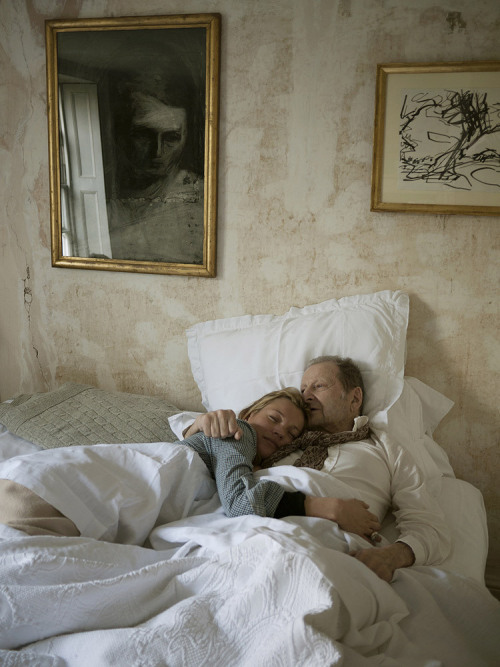
“Kate Moss & Lucian Freud in bed”
David Dawson
2010


Lucian Freud was one of the greatest realist paintings of the twentieth century. Family, friends and lovers were his subjects and sometimes when no-one else was available, himself. Sitters were drawn from all walks of life, from the aristocracy to the criminal underworld, but he rarely took on commissions. Freud's portraits often recorded the life of a relationship. Highly personal and private they are a record of time spent behind the closed door of the studio. The exhibition spans seven decades and is arranged chronologically, beginning with his early explorations of portrait.
Freuds early portraits are very flat and illustrative, they are almost unrecognisable from his later more recognised works.
I must admit I enjoyed the exhibition a lot more than I first thought, looking at Freud's earlier works through to his very last unfinished painting before he passed away last year aged 88. A lot of the paintings have a strange uneasy feeling about them when you catch the eye of the sitter. It has been said that freud would arrange the sitter a certain way, perhaps giving them a chair or just the cold wooden floor to pose upon. Within the paintings are a tremendous amount of detail and tone, what you don't get from looking at the photographs of Freud's work is the harsh texture of the paint. However you can see the way he studies a persons presence and aesthetics, it's almost as though he is describing them through painting them as well as the experience and tensions of being in a room with the sitter.


Images taken from postcards


“Kate Moss & Lucian Freud in bed”
David Dawson 2010

Image available at: http://enversendroit.tumblr.com/post/19230062087/kate-moss-lucian-freud-in-bed-david-dawson. Last Visited. 6th Apr 2012


Man with a Feather (Self-portrait), 1943.
Image available at: http://www.guardian.co.uk/artanddesign/gallery/2012/feb/08/lucian-freud-national-portrait-gallery. Last Visisted. 6th Apr 2012

Tate Modern - Yayoi Kusama

Yayoi Kusama is one of Japans best know artist, since the 1940's she has worked excessively and has produced a large body of work including, painting, sculpture, drawing and collage as well as her large scale immersive installations which she is most recognised for. Her work reflects her unique vision of the world and has an almost 'hallucinatory intensity'. This exhibition is a representative selection of her work from her career as an artist which has lasted over 60 years. 
I decided to attend this exhibition as I was passing by and thought it looked interesting. I didn't have much knowledge about Kusama so I entered the exhibition with an open and willing mind. I found myself walking around quite confused and with my mouth open at the huge immersive instilations. In particular I enjoyed the mirrored room with the infinite lights, I find the concept hypnotising and I could have quite happily sat in there for a few hours. Quite clearly Kusama is a very disturbed woman as she has voluntarily lived in a psychiatric institution since 1977 which is apparent from the repetitive manor in which she works.
"This concern with obliteration and overwhelment moves through Kusama’s work as we enter the 1960s. We see chairs, suitcases and boats that she covered with phallic, spongy white shapes, or jackets covered in silver macaroni. Her use of griddy, repetitious images on wallpaper prefigures what Andy Warhol would do with his cow prints a few years later. As psychadelia and hippy culture began to take off, Kusama began making performances, covering the naked bodies of participants in spots and dots, hosting orgies, gay weddings and experiences in which she hoped people could feel obliterated, connected to the universe.
I saw this exhibition at the Pompidou, and Tate have done a much better job with it here. The hang is cleaner, and there is a less wacky, more threatening atmosphere, emphasising Kusama’s mental illnesses and hallucinations. The spots are ominous in their domination in works like I’m Here, but Nothing(2000/2012), where bright fluoro dot stickers cover a dark, domestic room with sofa, tables, chairs and TV, every spot illuminated by UV light and blocking the world behind it. There’s no escape, they seem to say." 


All images were scanned from booklet from exhibition and postcards. Information also taken from booklet.


Laura Mclean-Ferris. (2012). Yayoi Kusama, Tate Modern, London. Available: http://www.independent.co.uk/arts-entertainment/art/reviews/yayoi-kusama-tate-modern-london-7440491.html. Last accessed 6th Apr 2012.


Friday, 6 April 2012

Tony's

 (http://www.tonysgallery.com/)


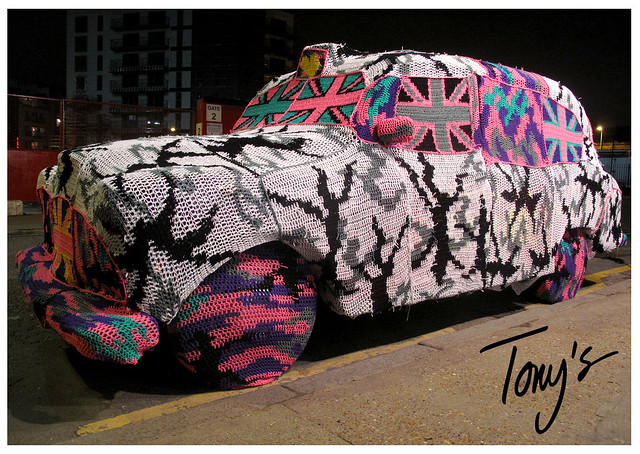
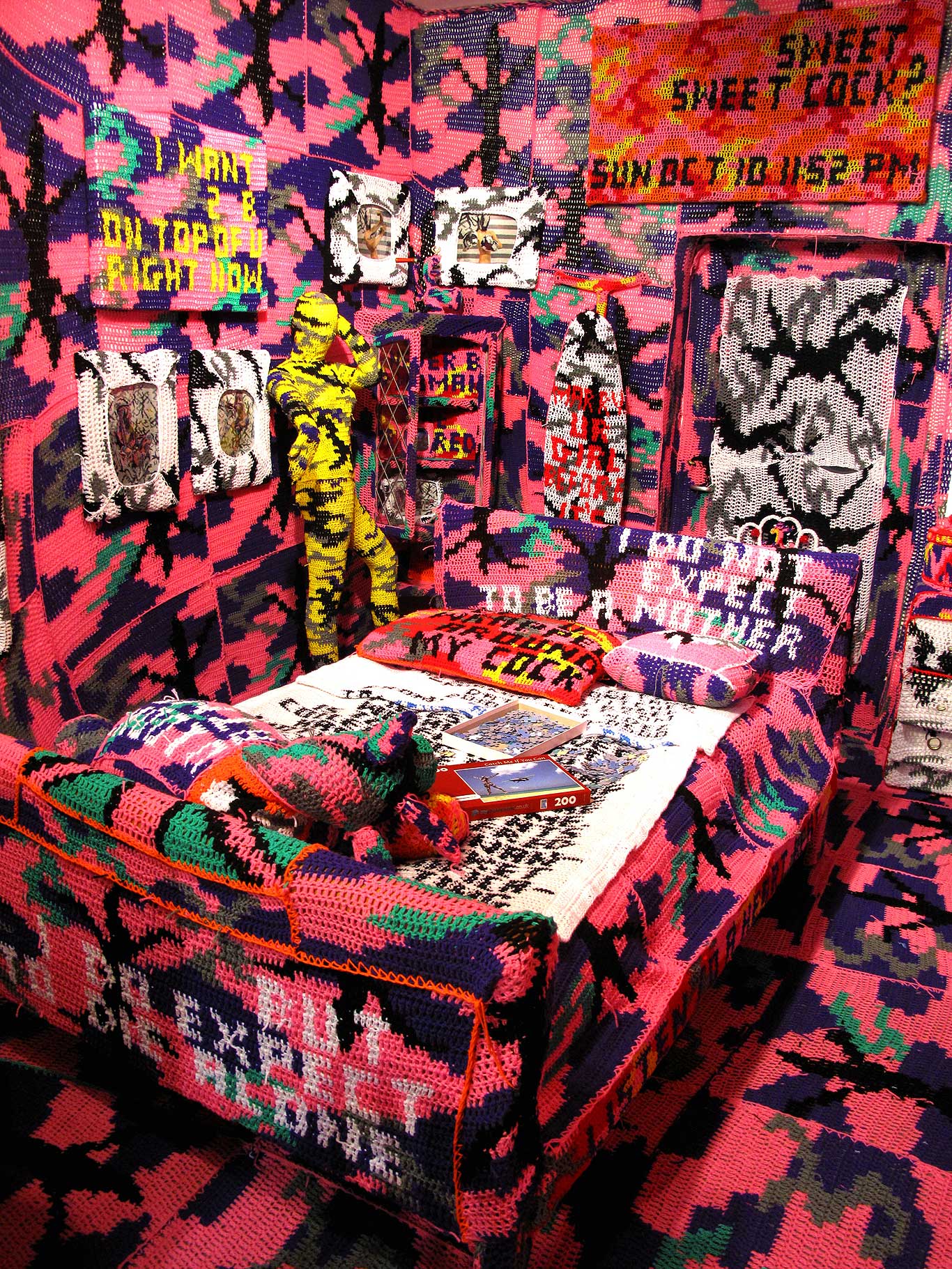
The current exhibition is by OLEK entitled "I do not expect to be a mother but I do expect to die alone" Open 27th January - 23rd March. Which is her first solo exhibition the Polish Born, New York based artist is renowned for her crocheted yarn works which she uses indoors and on the streets. In this exhibition the artist has covered an entire room in crochet. Her work is both rich in colour and in metaphors, there are explicit messages crocheted into objects that reveal her position as a female in the art world which is inclined to have a sexist opinion. Text-based pieces are actual representations of SMS messages sent to the artist, an insight into her intimate and past relationships. You become a viewer of the artists personal history as she touches upon modern day concerns such as privacy, technology and communication. 
At a first glance I wasn't too keen on the general aesthetics of the artists work, although very impressed at the scale and ideas behind it all. The experience of the exhibition was also impressive, upon arrival you were asked to either cover your shoes or take them off so you could inspect the exhibition space in an intimate way. You notice objects and texts originally out of sight and you begin to experience the work rather than the norm of spectating. 


Tony. (2012). OLEK. Available: http://www.tonysgallery.com/?p=797. Last accessed 6th Apr 2012.

Identity - Gender

"Men look at women, women watch themselves being looked at." -John Burger


The male gaze happens when the camera puts us into the perspective of a heterosexual man, the woman is displayed as an erotic object for both the character within the frame as well as for the spectator. The man is the dominant power within the fantasy and the woman is passive to the active gaze of the man. The first advertisement plays on using the woman as a trophy, the woman is portrayed as the price you pay for the Lynx shower gel and you get the woman because she is an object. She's something you can buy. Even in Renaissance women were painted nude exclusively for the male viewer, their head was often turned away and gazing into a mirror but with their body facing the viewer to show they are aware of the male gaze - relating back to John Burgers statement. 


"In the seventies, advertising and photography was controlled by men. Women in the real world were working for better prospects and opportunities, but the patriarchal media persisted in regurgitating all the old female stereotypes where the chasm between the real and the represented ("fact and fantasy") was wide and growing. The Gender Trap, a book by Carol Adams and Rae Laurikietis identified five dominant stereotypes: the carefree girl, the career woman, the hostess, the wife and the model (Myers 1986, 88). The constructed model stereotype was considered to be the most divergent of all from a real life woman; always perfectly dressed and made up, always in an exotic location and never seen in real domestic situations."

Unknown. (unknown). The Male Gaze. Available: http://www.firstpages.com/hauschild/photography/AIB/AIB/PG.htm. Last accessed 6th Apr 2012.

images- Mariana de Oliveira. mari_skywalker@hotmail.com. The male gaze - Advertising. 6th Apr 2012.

Semiotics

StolenSpace Gallery - Love & Hate Group Show
10.02.12 - 15.04.12


Love and Hate is a group show by various artists with the use of mix media. Each artist featured in the exhibition has produced a series of two images in which to represent Love and Hate. The images are clearly contrasting and it seems to be fairly obvious as to which piece of art work represents which emotion/feeling. 


 These were my favorite pieces from the exhibition The first by David Bray, Chloe Early, Charles Krafft and word to mother.
When asked what you associate with the words Love and Hate I’m sure a whole host of images come to mind, yet we all clearly have different loves and hates despite still being able to differentiate which painting etc represents which word.
I think perhaps Brays illustrations on the wood are the most difficult to tell apart, however I think once you study them it becomes fairly obvious. The first painting represents hate the things that connote this to me is the hard chiseled jaw line of the girl where as the one below is very contrasting she has a rounded softened jaw which is much more friendly and embracing. The gaze of the girls is also contrasting, the girl in the hate illustration has smaller narrowed eyes that appear to be more threatening and insincere with her head also titled backwards it appears she is looking down at us. The girl featured in the love illustration has a much more direct forward facing head position; her eyes are wider which has a desiring and friendly essence about it.


Stolen Space. (2012). Love & Hate. Available: http://www.stolenspace.com/section.php?xSec=506&xPage=1. Last accessed 6th Apr 2012.